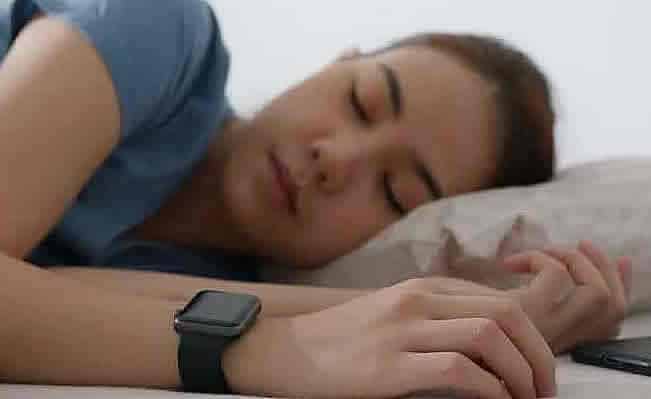
Track your sleep quality with your smartwatch
In the years I’ve spent testing wearables and talking to the engineers behind the sensors, I’ve realized something: we are all a little bit obsessed with our sleep data. Whether you’re rocking an Apple Watch or a Samsung Galaxy, there’s a specific kind of morning ritual where we check our wrist before even rubbing the sleep out of our eyes. We want to know if that restless feeling matches the graph on the screen.
But here is the thing—modern smartwatch sleep tracker technology is both a miracle of engineering and a giant game of educated guessing. Having worked on the periphery of this industry, I’ve seen the back-end data that manufacturers don’t usually put in the glossy marketing. Your watch isn’t actually seeing you sleep; it’s using light and motion to tell a story.
In this guide, I want to break down everything you need to know about your smartwatch sleep tracker, from what those confusing sleep stages actually mean to the troubleshooting secrets that can fix a glitchy device.
How Your Watch Actually Knows You’re Asleep
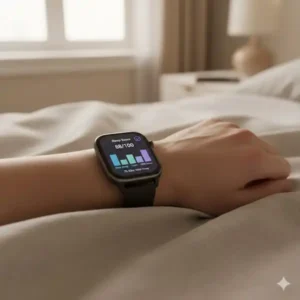
I remember a conversation with a hardware developer who joked that a smartwatch is basically a tiny accountant living on your wrist. It doesn’t feel your fatigue; it counts data points. Most modern devices use a combination of three things:
- The Accelerometer: This detects movement. If you’re still for a long time, the watch assumes you’re drifting off.
- The PPG Sensor: Those green lights on the back measure your heart rate. When you sleep, your heart rate usually drops and your heart rate variability changes.
- The SpO2 Sensor: This monitors blood oxygen levels. It’s a newer addition that helps flag potential breathing issues like sleep apnea.
The insider secret? The software is often more important than the hardware. Two different watches can have the exact same sensors, but because their algorithms interpret restlessness differently, they’ll give you two different sleep scores. This is why you shouldn’t switch between brands if you’re trying to track a long-term trend; pick one and stick with it so the bias is consistent.
What Do My Sleep Stages Mean?
This is the big question everyone asks. You open your app and see a colorful bar chart: Light, Deep, REM, and Awake. What are you supposed to do with that?
Light Sleep (The Entry Level)
Most of your night—roughly 50%—is spent here. In the industry, we often call this junk sleep, though that’s a bit unfair. It’s when your body is still responsive to the environment. According to the Sleep Foundation, light sleep is essential for memory processing and metabolic regulation, even if it doesn’t feel as productive as the deep stuff.
Deep Sleep (The Body Shop)
This is the holy grail. During deep sleep, also known as slow-wave sleep, your heart rate and breathing are at their lowest. This is when your body physically repairs itself. It’s when growth hormones are released and your immune system gets a boost. From my experience, if you wake up feeling physically heavy or sore, you likely missed out on your deep sleep cycles. Pro tip: Deep sleep usually happens in the first half of the night, so that late-night movie is literally stealing your physical recovery time.
REM Sleep (The Brain Clean)
Rapid Eye Movement (REM) is when the theatre of the mind opens. This is when you dream. Your brain activity actually looks very similar to when you’re awake, but your body is paralyzed so you don’t act out your dreams. Johns Hopkins Medicine notes that REM is crucial for emotional regulation. If you’ve ever felt cranky or foggy for no reason, check your REM stats. Unlike deep sleep, REM cycles get longer as the morning approaches.
Awake (The Reality Check)
Every smartwatch sleep tracker will show you were awake for 15–40 minutes, even if you don’t remember it. Don’t panic. These are micro-awakenings. Your brain checks your surroundings—Is the room too hot? Is that noise a threat?—and then you go back under. If your watch says you were awake for 30 minutes, you’re actually doing just fine.
Troubleshooting: When the Data Goes Dark
I’ve had mornings where my watch told me I got zero minutes of sleep while I was clearly lying in bed. It’s frustrating. Before you return the watch, try these insider fixes that usually solve the problem for both Android and iPhone users.
1. The Two-Finger Rule
Accuracy begins with placement. If the watch is too loose, the green light (PPG sensor) scatters, and the watch loses your pulse. If it’s too tight, you’re restricting blood flow, which also messes up the reading. You should be able to fit two fingers between your wrist bone and the watch band. This keeps the sensor flush against the skin without being a tourniquet.
2. The Battery Trap
Most watches (especially the Apple Watch) have a safety floor. If your battery is below 30%, the watch may prioritize staying alive over running the high-intensity heart rate sensors needed for your smartwatch sleep tracker to function. I’ve made it a habit to toss my watch on the charger while I’m in the shower—that 30-minute boost is usually enough to get through the night.
3. Software Conflicts
On iPhones, ensure your Sleep Focus is actually turned on. If the watch doesn’t know you’re trying to sleep, it might ignore subtle data cues. On Android (especially Samsung), check if Power Saving Mode is on. Most power-saving modes disable the very sensors needed for an effective smartwatch sleep tracker. It’s a classic oops moment that I see all the time.
4. The Hairy Wrist Problem
It sounds funny, but it’s real. Dense arm hair or even dark tattoos can block the light sensors. If you’re getting no data, try moving the watch to the inside of your wrist—the skin there is usually smoother and lighter, providing a much cleaner signal for the sensors to read.
Living with Your Data: A Reality Check
I once spent a month obsessed with my sleep score. If I got an 85, I felt great. If I got a 62, I felt like a zombie—even if I actually felt fine when I woke up. This is a real phenomenon called Orthosomnia.
Remember: your smartwatch sleep tracker is a compass, not a GPS. Use it to spot trends. If you notice your deep sleep drops every time you have a glass of wine at 9:00 PM, that’s a useful insight. But if the watch says you slept poorly and you feel energized? Trust your body over the silicon. The Mayo Clinic emphasizes that individual sleep needs vary, so don’t get hung up on a single night’s number.
Frequently Asked Questions (FAQ)
Q: Can my smartwatch sleep tracker detect sleep apnea? A: Some high-end models are now FDA-cleared for sleep apnea notifications. However, most watches just show Oxygen Saturation (SpO2). If you see frequent drops below 90%, it’s worth taking that data to a doctor, but the watch itself isn’t a diagnostic tool.
Q: Why does my watch think I’m asleep when I’m just reading? A: This is the inactivity bias. If your heart rate is low and you aren’t moving your arm, the algorithm assumes you’ve drifted off. Most apps let you edit your sleep times manually to fix this.
Q: Do I need to wear my watch every night? A: To get a baseline, yes. Most algorithms need about 7 to 14 days of consistent wear to understand what normal looks like for your specific heart rate and movement patterns.
Q: Why is my data different on my phone vs. my watch? A: This usually happens because of a sync lag. Ensure your Bluetooth is on and open the companion app to force a data handshake.
Q: Does the Smart Alarm actually work? A: These alarms try to wake you during light sleep so you don’t feel groggy. In my experience, they are hit-or-miss. They work best if you have a wide wake window (e.g., wake me between 7:00 and 7:30).
Final Thoughts from the Inside
The world of wearables is moving fast. We’re getting closer to clinical-grade data every year, but we aren’t there yet. Use your smartwatch sleep tracker to learn about your habits. Maybe you need a cooler room, or maybe you need to stop scrolling on your phone an hour before bed.
The data provided by a smartwatch sleep tracker can be a great motivator. I’ve found that seeing a low score actually makes me more mindful of my bedtime routine the following night. If a smartwatch sleep tracker helps you respect your rest just a little bit more, then it’s worth every penny. Just don’t forget to look up from the screen once in a while and ask yourself: how do I actually feel?
If your smartwatch sleep tracker is consistently giving you odd results despite troubleshooting, it might be time to recalibrate the heart rate sensors by performing a soft reset on the device.
Additional tips for using a sleep tracker app on a smartwatch:
- Wear your smartwatch snugly but comfortably.
- Make sure that the sensor is not obstructed by clothing or bedding.
- Avoid charging your smartwatch while you are sleeping.
- Enable sleep tracking before you go to bed and disable it when you wake up.
- Review your sleep tracking data regularly to identify any trends or patterns.
Comparison of Tracking Accuracy
In my experience switching between a dozen different devices over the last few years, I’ve found that no two brands are exactly alike. One watch might think I’m in a coma while I’m actually just watching a movie, while another thinks I’ve run a marathon because I had a restless night.
Accuracy is the “North Star” of the industry, but as any insider will tell you, a smartwatch sleep tracker is only as good as the research backing its algorithm. Independent studies, like those from the University of Antwerp or Johns Hopkins, have shown that some brands are significantly better at “seeing” through the noise.
Here is how the heavy hitters stack up when compared to medical-grade Polysomnography (PSG) equipment.
The Accuracy Showdown: Popular Brands Compared
| Brand / Model | Sleep Stage Accuracy | Wake Detection | Best For… | Insider Note |
| Apple Watch (Series 10/11) | High (κ ≈ 0.60) | Excellent | iPhone Users | Currently the gold standard for REM and Deep Sleep timing. |
| Fitbit (Charge 6 / Sense 2) | High (κ ≈ 0.55) | Good | Overall Insights | The best at identifying “Sleep Animals” and long-term habits. |
| Samsung Galaxy Watch 7/8 | Moderate | Moderate | Android Users | Features great “Sleep Coaching” but can be over-sensitive to movement. |
| Garmin (Venu 3 / Fenix 8) | Moderate | Fair | Athletes | Often “misses” brief wake-ups but excels at tracking HRV recovery. |
| Whoop 5.0 | High | Excellent | Optimization | The sensor is incredible at detecting Deep Sleep but lacks a screen. |
| Oura Ring 4 | Very High | Excellent | Comfort | Form factor allows better signal quality than most wrist wearables. |
Note: The “κ” (Cohen’s Kappa) score is a statistical measure where 1.0 is perfect agreement with a sleep lab. Most top-tier devices fall between 0.40 and 0.65.
Why the Gap Exists
I once asked a product manager why their watch kept missing my 3:00 AM water breaks. The answer was fascinating: conservative vs. aggressive algorithms. * Apple uses an aggressive approach. Their smartwatch sleep tracker looks for very specific heart rate signatures to switch stages. This makes them highly accurate for REM detection, as noted by Sleep Foundation research.
- Garmin tends to be more conservative. They prioritize “Total Sleep Time,” so they might “smooth over” a five-minute period where you were tossing and turning to give you a more encouraging score.
My Personal Recommendation
If you’re on an iPhone, the Apple Watch is honestly hard to beat for raw data accuracy. However, if you’re like me and hate charging your watch every single day, the Fitbit ecosystem still offers the most “human” interpretation of sleep data. They don’t just give you numbers; they tell you if you’re a “Hedgehog” or a “Bear” based on your consistency.
No matter which smartwatch sleep tracker you choose, remember that the most important metric isn’t the score on the screen—it’s how you feel when your feet hit the floor.
Additional Helpful Information
- Take a look at some smartwatch features – What Are The Basic Smartwatch Features? – Best Tips and Tricks