How to Save and Extend Smartwatch Battery Life
It happened to me last Tuesday. I was halfway through a morning hike, relying on my watch for GPS and heart rate tracking, when I felt that dreaded haptic buzz. “10% Battery Remaining.” By the time I reached the trailhead, my wrist was wearing a very expensive, very dead piece of glass and silicone.
If you’re reading this, you’ve likely felt that same frustration. We buy these devices to keep us connected, but we end up being slaves to the charging puck. I’ve spent years tinkering with wearables—from the early Pebble days to the latest Ultra and Galaxy models—and I’ve worked alongside technicians who see the “guts” of these things every day. The truth is, most of the “official” advice is just a band-aid. If you want to Extend Smartwatch Battery performance, you have to look at how the software actually behaves in the real world.
The Post-Update Drain: Why Your Battery Tanks After a Software Refresh
We’ve all been there. You install the latest version of watchOS or Wear OS, excited for new features, only to find your battery life halved overnight.
Whenever a major update rolls out, your watch isn’t just “idle” when you aren’t looking. It’s often performing massive background tasks like re-indexing your local files, migrating databases, and recalibrating the battery controller. From my experience, the best thing you can do to Extend Smartwatch Battery life after a big update is to give it 48 hours to “settle.”
However, if it stays bad, it’s usually because a specific background process got “stuck.” On Android watches, I’ve found that the “Media Controls” service often goes rogue after an update, constantly pinging the phone to see if music is playing. On Apple Watches, it’s often the “Environmental Noise” monitoring that suddenly decides to be more aggressive. A simple restart is step one, but a “forced restart” (holding both buttons until the logo appears) is what actually clears that system cache and helps Extend Smartwatch Battery longevity.
The “Hidden” Drains: What Your Manual Won’t Tell You
Manufacturers love to tout 24/7 heart rate monitoring, but they don’t tell you it’s the single biggest hardware tax besides the screen.
- The “Hey Google” and Siri Tax: Your watch has a dedicated “low-power” chip just for listening for your voice. In theory, it’s efficient. In practice, in a noisy environment, that chip is constantly firing, trying to parse sounds into commands. Turning off “Always Listening” and switching to a long-press of the crown or side button can save you a solid 10-15% a day.
- The LTE Trap: If you have a cellular model, your watch is designed to hunt for a signal the moment it loses Bluetooth contact with your phone. I once spent a day in a basement office with a weak LTE signal; my watch was dead by 3 PM because it was cranking its radio to 100% just to stay connected. If you’re in a low-signal area, manually toggle Cellular to “Off” to Extend Smartwatch Battery life.
- Third-Party Complications: I love a good weather complication, but some third-party apps are coded poorly. They might request a GPS location every 15 minutes instead of using the phone’s cached data. Stick to native complications where possible to Extend Smartwatch Battery efficiency.
Real-World Troubleshooting: My “Deep Freeze” Method
If your battery is still plummeting, you need to find the culprit. I call this the “Deep Freeze” method.
First, switch to the simplest, darkest watch face you have. Since most modern smartwatches use OLED screens, every black pixel is a pixel that is literally turned off. If you use a bright, white, or colorful face, you are burning energy across every square millimeter of that display.
Second, go into your settings and look at “Background App Refresh” (on Apple) or “App Usage” (on Android). I’m ruthless here. If I don’t need a notification for an app on my wrist, I kill its background permissions. Do you really need your LinkedIn notifications synced to your watch in real-time? Probably not. Reducing this noise is the most effective way to Extend Smartwatch Battery performance without losing the features you actually use.
When Software Isn’t Enough: Smartwatch Battery Replacement
There comes a point where no amount of settings-tweaking will help. Lithium-ion batteries have a shelf life. Typically, after about 300 to 500 full charge cycles, the chemical health drops below 80%. This is when you start seeing “voltage sag”—the watch might show 20% and then suddenly shut down because the battery can’t provide enough peak power for a notification vibration.
In the industry, we call this the “cliff.” If your watch is more than two or three years old and you’re struggling to Extend Smartwatch Battery life through settings, it’s time to look at a smartwatch battery replacement.
For Apple users, the process is straightforward but pricey if you aren’t under AppleCare. Apple doesn’t actually “repair” your watch in the store; they usually swap it for a refurbished unit of the same model with a fresh battery. For Android users (Samsung, Pixel, Fossil), it’s a bit more “Wild West.” I’ve seen local repair shops handle these, but because smartwatches are held together with industrial-grade waterproof adhesive, it’s a delicate job. If you do it yourself, you will almost certainly lose your water resistance. Always ask a technician if they use a “pressure-sensitive adhesive” (PSA) gasket when resealing the device. If they don’t, keep that watch far away from the shower.
The Insider’s Guide to Charging Habits
I once talked to a hardware engineer who told me the “100% habit” is killing our devices. We’ve been conditioned to charge our devices to 100% every night. However, keeping a battery at maximum tension (100%) or letting it bottom out to 0% creates significant chemical stress.
To truly Extend Smartwatch Battery health over the long term, try to keep it between 20% and 80%. Many modern watches now have an “Optimized Battery Charging” feature that learns your schedule and holds the charge at 80% until just before you wake up. Leave this on. It might mean you have 5% less “juice” for a single day, but it adds six months to a year of total life to the hardware itself.
The “Aftermarket” Reality
A lot of people ask me about those cheap $10 charging pucks from Amazon. Here is a bit of insider knowledge: don’t use them. Cheap chargers often have poor voltage regulation. I’ve seen “phantom” battery drains caused by a watch’s charging IC (integrated circuit) getting slightly fried by a surge from a low-quality charger. The watch thinks it’s charging, but it’s actually just generating heat, which is the #1 enemy of battery longevity. To Extend Smartwatch Battery life, stick to the puck that came in the box or a certified brand like Belkin or Anker.
Comprehensive Troubleshooting Checklist
If you’re still struggling, run through this list. I’ve used these steps to fix hundreds of “broken” watches over the years:
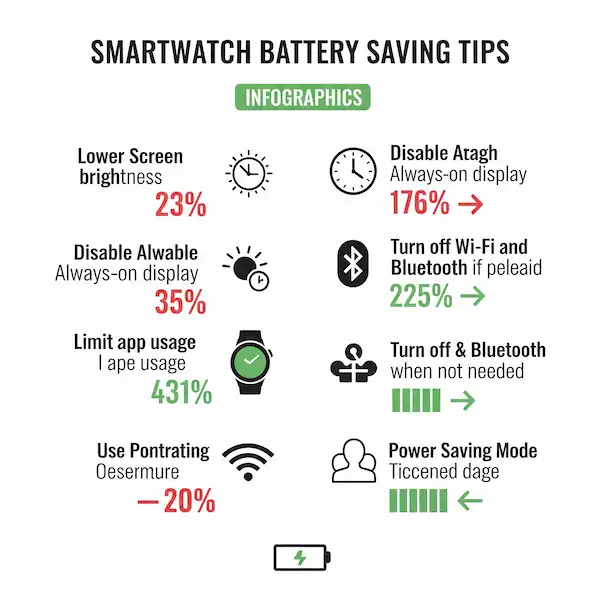
- The Brightness Check: Set it to “Auto,” but then nudge the slider down one notch. Your eyes will adjust, and your battery will thank you.
- The Haptic Audit: Do you need a “strong” vibration for every single email? Switch haptics to “Standard” or “Light.” Those tiny motors take a lot of juice to spin up.
- The Wi-Fi Ghost: If your watch is always near your phone, turn off the watch’s Wi-Fi. It’s only there as a backup, but it will occasionally “sniff” for networks, which wastes energy.
- The GPS Lockdown: Only allow apps to use your location “While Using.” Some fitness apps will try to ping your location in the background to “warm up” the GPS. It’s a battery killer.
- The Update Cycle: After any update, check your “Display” settings. I’ve seen updates reset “Always On Display” to “On” even if you had it off before.
Summary of Daily Maintenance
To consistently Extend Smartwatch Battery life, I make it a habit to check my battery graph once a week. Both Android and iOS now offer a breakdown of which apps used the most power. If I see an app like “Maps” or “Spotify” at the top when I haven’t even used them that day, I know a process is hung. I’ll force-close the app or, if necessary, delete and reinstall it.
We often treat our watches as “set it and forget it” devices, but they are full-blown computers on our wrists. They need a little digital housekeeping.
Frequently Asked Questions (FAQ)
Q: Does using a “Busy” watch face really drain the battery? A: Absolutely. Each “complication” (the little widgets for weather, steps, etc.) requires the watch to wake up the processor to fetch data. To Extend Smartwatch Battery life, keep it to 2 or 3 essential complications.
Q: Is “Power Saving Mode” safe to use all the time? A: It’s safe, but it turns your “Smart” watch into a “Dumb” watch. It usually kills heart rate tracking and notifications. It’s a great tool when you’re at 15%, but I wouldn’t recommend it for daily use if you want the features you paid for.
Q: Why does my watch get hot while charging? A: A little warmth is normal, but “hot to the touch” is a bad sign. It usually means the battery is struggling to move ions, or your charger is faulty. Heat is a major reason people eventually need a smartwatch battery replacement.
Q: Can I replace the battery myself? A: If you’re handy with a heat gun and tiny screwdrivers, yes. But be warned: the ribbon cables inside are thinner than a human hair. One slip and the screen is toast. For most people, a professional repair is the better way to Extend Smartwatch Battery life on an old device.
Q: Does “Raise to Wake” use a lot of battery? A: It uses the accelerometer. While the sensor itself is low-power, the screen turning on 100 times a day because you’re a “hand talker” will absolutely crush your battery.
Final Thoughts
At the end of the day, your watch is a tool. You shouldn’t have to baby it, but a few smart choices can make the difference between a device that lasts two days and one that leaves you stranded. Whether you’re trying to Extend Smartwatch Battery life on a brand new Series 10 or trying to squeeze one more year out of an old Galaxy Watch, the secret is always in the settings you don’t see.
For more technical deep dives into battery chemistry, I highly recommend checking out Battery University for the science behind lithium-ion, or the repair guides at iFixit if you’re considering a smartwatch battery replacement. If you’re on the Apple ecosystem, the Apple Support Battery Page is actually quite helpful for understanding “peak performance capability.”
Don’t let the “low battery” warning dictate your day. Take control of those background processes, be mindful of your charging habits, and your watch will actually be there when you need it most.
Remember, the goal to Extend Smartwatch Battery life is a marathon, not a sprint. Small, consistent changes in how you use the device will yield the best results over the lifespan of your wearable. If you’ve found a trick I didn’t mention, or if you’ve had a nightmare experience with a smartwatch battery replacement, I’d love to hear about it—because the best knowledge in this industry always comes from the community, not the marketing brochures.
Additional helpful information:
Here a solution for what to do if your watch won’t turn on.